Transport & Hauling
Local box logistics — pickup, relay, delivery.
Request: Transport & Hauling
One form covers it — we’ll follow up by email within one business day.
- Buy, sell, recycle, haul & upcycle — all in one request.
- Graded stock so you never overpay for a box.
- Chicagoland-local pickup & delivery.
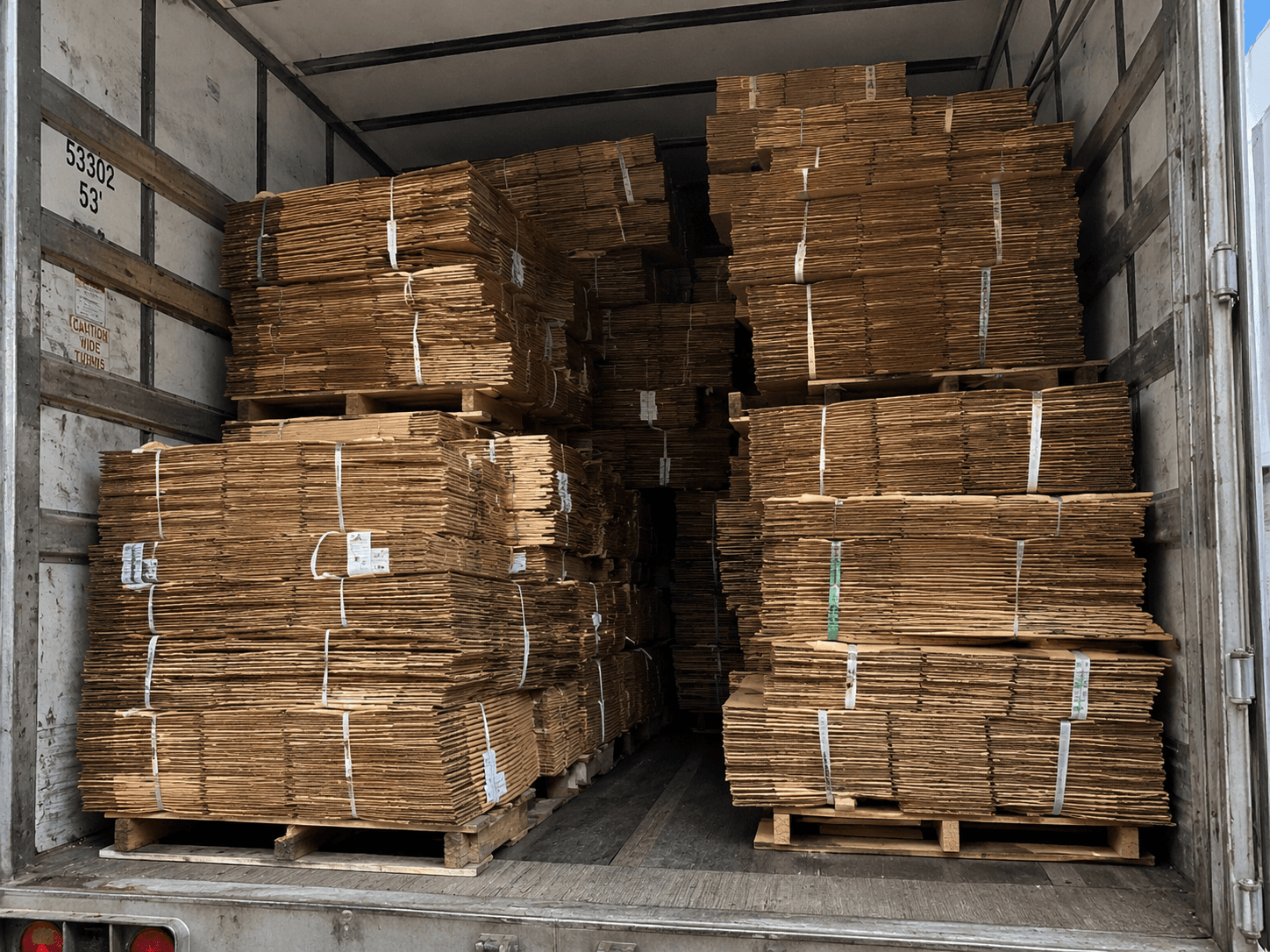
Boxes are bulky and light — the worst thing to ship long distances. Our local fleet moves box stock efficiently around Chicagoland: collecting surplus, relaying between your sites, and delivering graded stock.
- Chicagoland-focused for low-mile, low-carbon moves
- One-time clean-outs and standing routes
- Site-to-site relays for multi-warehouse operations
How it works
Schedule
Book a one-time or recurring run.
We move it
Trucks and trailers sized to your volume.
Confirm
Counts confirmed at both ends.
Local box hauling that cuts cost and carbon at once
The haul desk moves boxes so you do not have to. Pickups from your dock, relays between your own sites, and deliveries of graded stock all run on short local routes out of Alsip. Because the miles are low and the loads are combined, hauling with us tends to cost less and emit less than long-distance freight or half-empty in-house trucks.
Pickup, relay and delivery
Three movements cover most needs. Pickup collects surplus or recyclable boxes from your location and brings them to us. Delivery carries graded stock you have bought to your dock. Site-to-site relay moves boxes between two of your own facilities without routing through our warehouse at all.
Each movement draws on the same local fleet and the same scheduling, so combining them is straightforward. A single visit can drop off graded boxes and pick up your surplus in one stop, which is where the real efficiency lives.
Whatever the direction, the goal is the same: get boxes where they need to be with as few trips and as little empty running as possible.
Why low-mile local moves win
Distance is the biggest driver of both freight cost and transport emissions. A box that travels twenty miles to its next user carries a fraction of the fuel and carbon of one shipped across several states. Local logistics is therefore not just convenient; it is fundamentally cheaper and cleaner.
Our Alsip base sits inside the region we serve, so most routes are short by design. That geography lets us quote competitive hauling and still keep the environmental footprint low, a combination that long-haul freight cannot match.
Short routes also mean faster turnaround. When a pickup and a delivery are a few miles apart, we can act quickly rather than waiting to fill a long-distance load.
Site-to-site relays
Businesses with multiple locations often need boxes moved between them, from a location generating surplus to one that needs stock, or from a receiving site to a fulfillment site. Relays handle that directly, skipping the warehouse when the boxes do not need grading in between.
Direct relays cut a leg out of the journey. Instead of hauling to Alsip and back out again, we move the boxes on the straightest sensible path between your sites, saving both time and mileage.
For companies balancing inventory across facilities, a standing relay route can quietly solve a recurring headache, keeping each site supplied without anyone dispatching their own trucks.
Combining loads for efficiency
The single biggest waste in box logistics is empty space and empty return trips. We fight both by combining movements. When several customers on the same corridor need service in the same week, we build a route that touches multiple stops on one run.
Backhauls are the other lever. A truck delivering graded stock in one direction can pick up surplus on the way back, so it rarely returns empty. That doubling of purpose is how short local moves stay economical.
You benefit even if you only have one stop, because a fuller network route spreads fixed costs across more boxes and keeps your price down.
One-time versus recurring routes
Some hauls are single events: a move, a clean-out, a one-off delivery. We schedule those as standalone windows around your dock hours. Simple, done, settled.
Recurring needs are better served by a standing route. If you generate surplus weekly or take delivery on a regular cadence, we lock in a schedule and a corridor so the movement becomes routine and predictable, with better economics than repeated one-offs.
Many customers begin with a single haul and shift to a recurring route once they see how much smoother it is not to arrange transport each time. Tell us your rhythm and we will suggest the right structure.
Scheduling that fits your dock
Good logistics respects your operation. We schedule pickups and deliveries around your dock hours, staffing and space, so trucks arrive when you can actually receive them rather than when it is merely convenient for us.
Everything is arranged in writing through info@boxeschicagoil.com, so the window, the stops and the load are all documented. That written trail prevents the missed-connection problems that plague verbal scheduling.
If your needs shift, a quick email adjusts the plan. Standing routes are meant to flex with your volume, not lock you into a cadence that no longer fits.
Scheduling smarter box logistics
- Combine a delivery and a pickup into one visit
- Share your dock hours so windows fit
- Ask about corridor routes if you are near other stops
- Set a standing cadence for recurring volume
- Use direct relays between your own sites
- Palletize loads for faster loading and unloading
- Confirm the schedule in writing to avoid mix-ups
- Flag volume changes early so routes can adjust
Questions & answers
Do you only haul boxes you buy or sell?
Why is local hauling cheaper?
Can one trip handle both delivery and pickup?
What is a site-to-site relay?
Should I book a one-time haul or a standing route?
How do you schedule around my operation?
Local Logistics And Load Planning
Boxes are bulky and awkward, which makes moving them their own discipline. Our transport desk handles pickups, deliveries and haul-away across Chicagoland with load planning that keeps trucks full and routes tight. This layer covers how local logistics actually run, how loads are planned to control cost, what route types we use, and how to prepare a site so a haul goes fast. Efficient transport is what makes reuse-first economics work at scale.
Why Local Density Matters
Corrugated is high-volume, low-density freight, so the cost driver is space and time, not weight. Running tight local routes out of Alsip means shorter drives, more stops per run, and the ability to combine trips, all of which keep the per-unit cost down.
Long-haul makes little sense for used boxes; the transport can cost more than the material is worth. Keeping moves local preserves the economics of reuse and recycling, which is why we stay inside Chicagoland.
Density also means responsiveness. With accounts clustered nearby, we can slot a pickup or delivery into an existing route rather than sending a truck out for a single stop.
Load Planning Fundamentals
Good load planning starts with how material is presented. Flattened, palletized boxes cube out efficiently and load fast; loose piles waste truck space and handling time. The way a load is staged often matters more than the raw count.
We plan around cube, not just weight, because a truckload of boxes fills up on volume long before it hits a weight limit. Maximizing cube per trip is the main lever on transport cost.
Mixed loads are planned too. A run might carry a delivery out and a pickup back, so the truck is not returning empty. That backhaul efficiency is a real cost saver for combined accounts.
Route Types We Run
Different jobs call for different route structures. A dedicated run serves one large pickup or delivery when the volume justifies a full truck. A combined route bundles several nearby stops, which suits smaller lots.
Scheduled routes serve recurring accounts on a fixed cadence, keeping docks clear without a call each time. On-demand runs handle one-off cleanouts and surges when they come up.
Matching the route type to the job is how we keep cost predictable. A small lot on a combined route costs far less than sending a dedicated truck for it.
Site Access And Equipment
The physical dock shapes the whole job. Dock height versus ground level, forklift or pallet-jack availability, door clearances and staging space all determine how fast a truck can load and whether special equipment is needed.
Palletized material at a proper dock is fastest. Loose boxes in a back room, tight alleys, or no loading equipment all add time and can affect scheduling and cost.
Telling us the site details up front lets us bring the right truck and crew. Surprises at the dock are what turn a quick load into a long one.
Cleanouts And Surges
Warehouse cleanouts, moves and seasonal surges produce a lot of boxes fast. These are on-demand jobs where the priority is clearing space quickly while still diverting anything reusable rather than trashing it all.
We sort during the haul where possible: resalable and buyable stock pulled aside, clean OCC captured for recycling, and only true waste handled as disposal. A cleanout is rarely all one category.
Staging the site before we arrive, even roughly, speeds these jobs dramatically and lets us recover more value from what would otherwise be dumped in a rush.
Scheduling And Timing
We build pickups and deliveries around your operating hours and dock traffic. A haul that lands during your busy shipping window can block your own dock, so we aim for windows that fit your flow.
For recurring service, a fixed schedule removes the back-and-forth and keeps material from piling up. For one-offs, we set a window that matches truck and crew availability against your deadline.
Clear communication about deadlines and constraints up front is what keeps timing tight. The more we know about your dock, the more precisely we can plan.
How Transport Ties To The Other Desks
Transport is rarely just moving boxes; it is how the buy, sell and recycle desks reach your dock. A single run can drop a delivery, collect surplus we are buying, and haul the recycling, all reconciled on one account.
That integration is where combined trips pay off. Because the truck is already there, adding a pickup to a delivery or a recycling haul to a buy costs far less than separate runs.
Planning transport alongside the other desks is what makes one-visit, five-outcome service practical rather than theoretical.
Route Types
| Route Type | Best For | Cost Logic |
|---|---|---|
| Dedicated | Large single job | Full truck justifies run |
| Combined | Small nearby lots | Shared across stops |
| Scheduled | Recurring accounts | Fixed, predictable cadence |
| On-demand | Cleanouts, surges | Priced to the job |
| Backhaul | Delivery plus pickup | Truck not returning empty |
Site Readiness Impact
| Condition | Fast Load | Slow Load |
|---|---|---|
| Box prep | Flattened, palletized | Loose piles |
| Dock | Dock-height door | Ground level, no dock |
| Equipment | Forklift on site | Manual handling only |
| Staging | Near the door | Scattered in back |
| Access | Clear approach | Tight alley |
Make Your Haul Go Fast
- Flatten and palletize boxes so the truck cubes out efficiently.
- Stage material near the loading door before the truck arrives.
- Tell us your dock type and whether a forklift is available.
- Flag tight alleys or clearance limits in advance.
- Bundle deliveries and pickups into one visit when timing allows.
- Choose scheduled service if you generate boxes steadily.
- For cleanouts, rough-sort so reusable stock is not trashed.
- Share deadlines and busy shipping windows so timing fits.